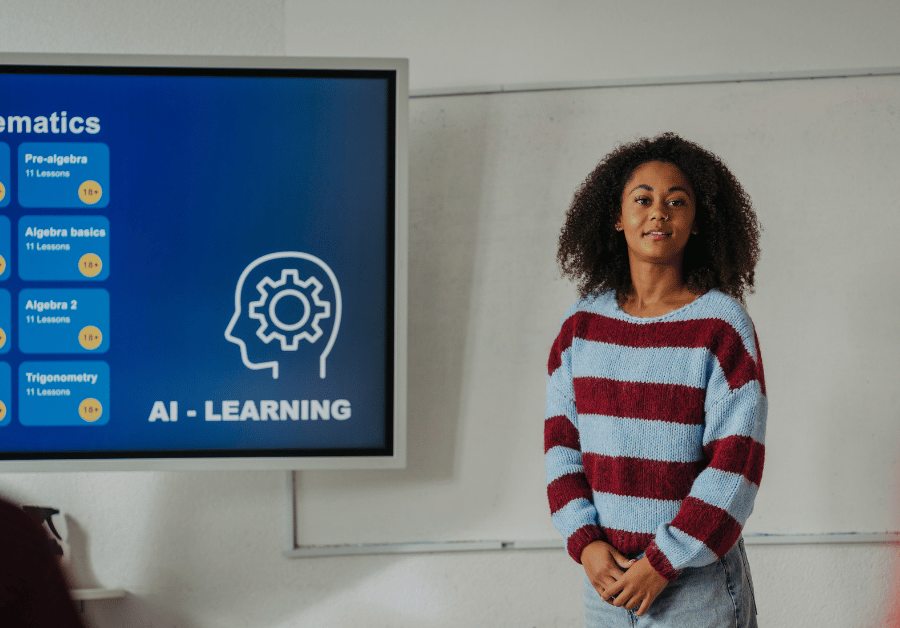
Higher education is undergoing one of the most significant technological shifts in its history. While chatbots and simple automation tools have been present on campuses for years, a new generation of technology — AI agents — is changing what’s possible. Unlike traditional AI tools that respond to single prompts, AI agents can plan, reason, take multi-step actions, and even collaborate with other systems to complete complex tasks with minimal human oversight.
For universities, colleges, and ed-tech leaders, understanding how AI agents in higher education are being deployed — and where the opportunities and risks lie — is no longer optional. It’s becoming a core part of institutional strategy.
What Are AI Agents, and How Are They Different from Chatbots?
An AI agent is a software system built on large language models (LLMs) that can autonomously pursue a goal by breaking it into steps, using tools (like databases, APIs, or search), and adapting based on feedback. Where a chatbot answers a question, an agent can:
- Research a topic across multiple sources
- Draft, revise, and format a document
- Schedule tasks, send reminders, or update records
- Coordinate with other agents or systems to complete a workflow
This distinction matters enormously in an academic setting, where processes often involve multiple steps, stakeholders, and systems — from admissions to grading to student support.
Key Applications of AI Agents in Higher Education
1. Personalized Learning and Tutoring
AI agents can act as always-available tutors, adapting explanations to a student’s pace, learning style, and prior knowledge. Instead of a one-size-fits-all lecture, an agent can generate practice problems, identify knowledge gaps, and adjust difficulty in real time — extending the reach of instructors, especially in large lecture courses.
2. Administrative Automation
Universities run on paperwork: enrollment, financial aid processing, transcript requests, and scheduling. AI agents can handle these multi-step administrative workflows autonomously, reducing the burden on staff and shortening turnaround times for students who depend on fast, accurate responses.
3. Research Support
Graduate students and faculty are using AI agents to accelerate literature reviews, summarize papers, identify research gaps, and even help structure grant proposals. Agents capable of searching, synthesizing, and citing sources can compress weeks of preliminary research into days.
4. Student Advising and Retention
Early-alert systems powered by AI agents can monitor academic performance, engagement, and attendance patterns, then proactively reach out to at-risk students or flag them for human advisors — supporting retention efforts at scale.
5. Curriculum and Content Development
Faculty are experimenting with agents that help design syllabi, generate assessment questions aligned to learning objectives, and adapt course materials for accessibility — all while keeping instructors in the loop for final review.
Benefits Institutions Are Reporting
- Scalability: Agents can support thousands of students simultaneously without proportional increases in staffing.
- 24/7 availability: Students get support outside office hours, which matters for working adults and international students across time zones.
- Reduced administrative overhead: Staff can focus on complex, high-judgment work rather than repetitive processes.
- Faster research cycles: Faculty and graduate students report meaningful time savings on literature review and drafting tasks.
Challenges and Risks to Consider
Adopting AI agents in higher education isn’t without friction. Institutions need to plan carefully around:
- Academic integrity: Clear policies are needed to distinguish appropriate agent-assisted work from academic dishonesty.
- Data privacy and security: Agents often need access to sensitive student records, requiring strict governance and compliance with regulations like FERPA or GDPR, depending on jurisdiction.
- Bias and equity: AI systems can inherit biases from training data, which can affect advising recommendations or grading support if not carefully audited.
- Over-reliance and skill atrophy: If students or staff lean too heavily on agents, critical thinking and independent problem-solving skills may suffer.
- Change management: Faculty and staff need training and buy-in; top-down mandates without support tend to fail.
How Institutions Can Get Started
- Start with a clear use case. Rather than deploying agents everywhere at once, pilot in one high-friction area — such as admissions inquiries or research support — and measure impact.
- Establish governance early. Define who owns AI policy, what data agents can access, and how decisions made by agents are reviewed.
- Involve faculty and students in design. Adoption succeeds when the people using the tools help shape how they’re implemented.
- Build in human oversight. Agents should augment, not replace, human judgment in high-stakes decisions like grading or admissions.
- Measure outcomes, not just adoption. Track whether agents are actually improving learning outcomes, retention, or efficiency — not just usage numbers.
The Road Ahead
AI agents in higher education are moving from experimental pilots to embedded infrastructure. Over the next few years, expect to see agents integrated directly into learning management systems, student information systems, and research workflows — often working together rather than as standalone tools.
The institutions that will benefit most won’t necessarily be the earliest adopters, but the ones that pair thoughtful implementation with strong governance, faculty training, and a genuine focus on student outcomes. AI agents offer real potential to make higher education more personalized, accessible, and efficient — but only when deployed with intention.
Leave a Reply
You must be logged in to post a comment.